Need help now? Support now: crisis lines by country.
Mathematical Institute for Research of Pain
Press and brand kit
For journalists, editors, podcasters and anyone writing about the Institute: what it is in a sentence and in a paragraph, the facts, the logo, its colours and its type.
Press questions: admin@painmath.org. A person reads every message.
In one sentence
The Mathematical Institute for Research of Pain (MIRP) works through the questions people in pain actually ask, in plain words and then in the mathematics: what is known, what is not yet known, and what would tell us.
In one paragraph
The Mathematical Institute for Research of Pain is for anyone who lives with pain, cares for someone who does, treats it or studies it. Its pages are written in layers, from plain words to the mathematics, so each reader can go as deep as they like; nothing is dumbed down, and you don’t need to be a mathematician. Inside are rooms built around teaching models, such as one that asks, from today’s state, whether a flare or a recovery comes first and how long the wait might be; the Pain Bias Codex, checks on conclusions about pain in four families; the Logic of Pain, 56 arguments about pain, each one’s form checked in Lean, the proof assistant; the Tropes of Pain, 49 entries in four decks, each with the step a listener may hear and whether it follows; the Table of Pain Targets; and a pain atlas. The Institute also makes Nociflux, an ecosystem for living with pain. It is in alpha, heading into beta testing, by invitation only; a few of its pages are public.
The facts
- Name
- Mathematical Institute for Research of Pain (MIRP), at painmath.org.
- Who it is for
- Anyone who lives with pain, cares for someone who does, treats it or studies it.
- Status
- In alpha, heading into beta testing, by invitation only. Anyone can ask for an invite at painmath.org/waitlist; a person reads every request and writes back by hand.
- Public pages
- The front door, Pain math, which explains what the Institute does, and Questions about pain, questions people in pain ask, each answered in plain words and then in the mathematics.
- What it is not
- The pages explain reasoning and evidence. Nothing here is medical advice or a forecast about any person, and the teaching models give no personal forecast.
- Licence
- Except where a page says otherwise, the Institute’s own text and figures are shared under CC BY-NC 4.0. Pictures and quotations from others keep their own credits and licences.
- Also made here
- Nociflux, an ecosystem for living with pain, on iPhone, Android and the web.
The logo
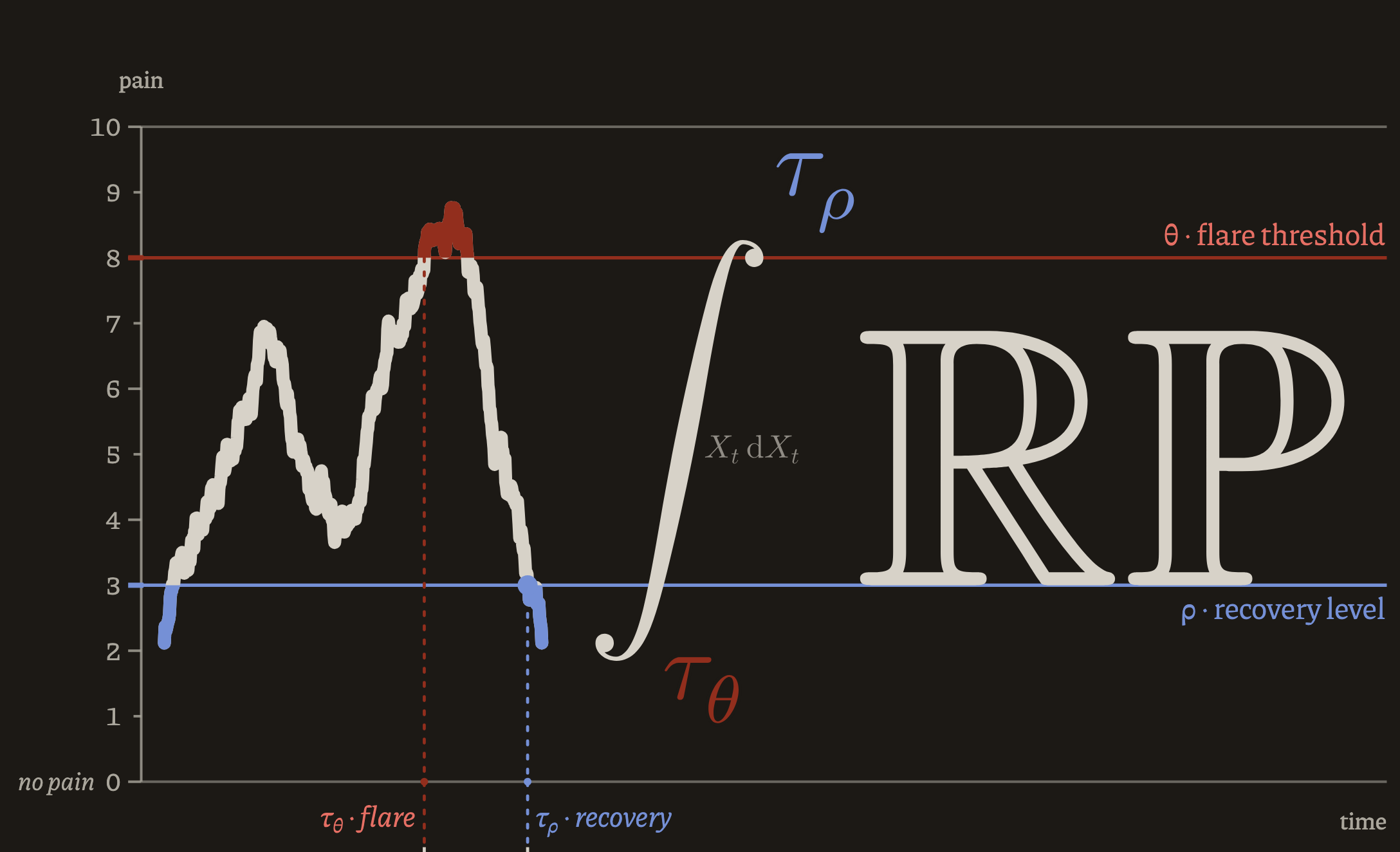
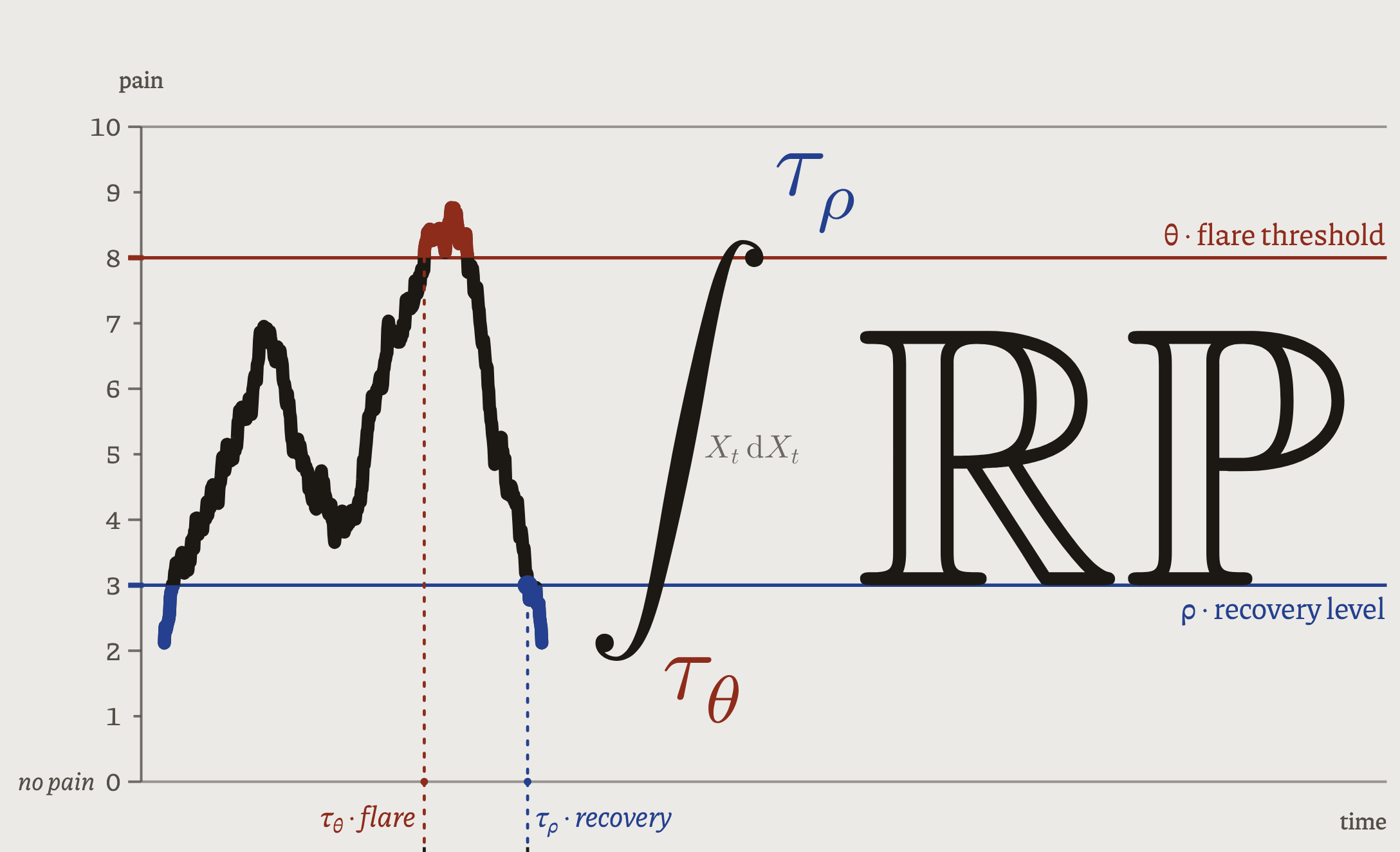
The logo is a piece of mathematics. Its M is drawn by tiny random steps, a coin flip each, that close in on one rough path; Monroe Donsker proved in 1951 that enough such steps always trace the jagged curve called Brownian motion. The M rises over a red flare line θ and comes back down to a blue recovery line ρ, on the 0 to 10 scale people in pain are asked about every day. The integral runs from τθ, when the flare begins, to τρ, when recovery comes: the stretch that treatment works to shorten. Read as words, the letters spell the name: M for Mathematical, ∫ for Institute, ℝ for Research, ℙ for Pain. The front door shows it forming, coin by coin.
Please use the logo as it is, with its scale, labels and colours: no redrawing, cropping out the scale, recolouring or added effects.
Colours
The logo carries meaning in two colours, always with the word beside them: red for the flare, blue for recovery.
- Flare red θ, τθ: #8E2A2A on light paper
- Recovery blue ρ, τρ: #24408E on light paper, #7590D6 on dark
Type
Piazzolla for titles and quotations, and Atkinson Hyperlegible Next, made by the Braille Institute for readers with low vision, for everything else; both are free under the SIL Open Font License. In the logo, ℝ and ℙ are the American Mathematical Society’s blackboard bold, the letters mathematicians use for the real numbers and for probability.
Need help now? Support now: crisis lines by country.
Except where a page says otherwise, the Institute’s own text and figures are shared under CC BY-NC 4.0. Pictures and quotations from others keep their own credits and licences.